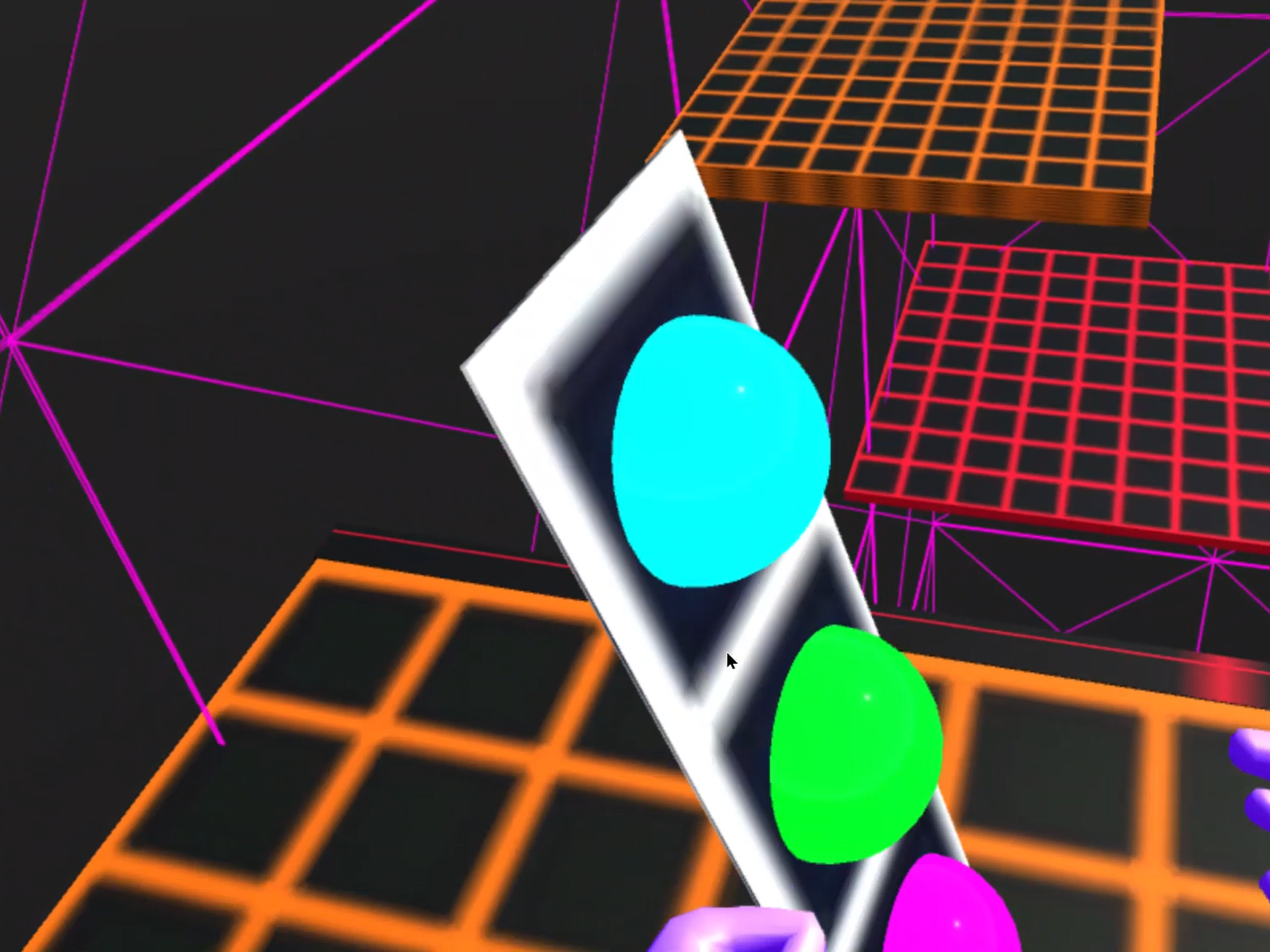
An end-to-end playthrough of Gràmar gu Leòr!
Gameplay:
Gràmar gu Leòr! (“grammar galore” in English) is a simple maze-based puzzle game. Inspired by The Witness, the game teaches Gaelic grammar implicitly: each new idea appears first in an easy puzzle, and is then built on in subsequent ones, allowing players to work out the Gaelic rules by playing rather than reading. It contains 24 maze puzzles across four levels (six to a level). Each puzzle gives the player an English sentence to translate into Scottish Gaelic by solving the maze. The player starts drawing the line by choosing a verb tense (past, future, or conditional, introduced gradually across levels), then collects a verb form by drawing the line through the corresponding symbol (positive or negative, statement or question).
Obstacles are scattered throughout the maze and can change the line as it passes through them: a Time Vortex removes the tense, returning the verb to its root form; a Confusifier strips the form, requiring another one to be acquired to finish the maze. These obstacles can help as well as hinder, and some puzzles can only be solved by using them. A Content Block obstacle, however, cannot be passed through and will impede progress, requiring a second line to be drawn to “break” it by answering its own prompt. When the player reaches the final puzzle in a level, the symbols are swapped for the real Gaelic verb forms. Players can navigate to previously solved puzzles at any time to refresh their memory of the tenses and forms. Learning is supported with Gaelic audio feedback: the verb root is spoken at the start of a maze, each form is spoken as it’s collected, and the complete Gaelic sentence is narrated when a maze is completed.
Research:
I based the design on a literature review and a survey of 11 learners from Gaelic evening classes in Glasgow. I then evaluated it in two playtests: one with seven adult Gaelic learners, and one with five students from other courses at GSA’s School of Simulation and Visualisation (SimVis) for comparison. Feedback from the playtests demonstrated that, while both groups enjoyed the game as a game, the learning outcomes were not as strong as I had hoped. The Gaelic learners found the mechanics difficult to learn, and some experienced confusion with the English grammar terms that the game relied on, such as “tense”. The SimVis students handled the gameplay easily, but did not come away with an improved understanding of Gaelic. Despite these results, the learners were enthusiastic about the potential of games for learning Gaelic, and the findings pointed to clear next steps for future work: more explicit instruction, and integration into existing classes to support ongoing learning.
Credits:
Backgrounds and props sourced from Creative Commons clipart. Gaelic audio generously provided by MG ALBA.